
CONTENTS
1. Welcome 3
2. About This Guide 4
3. Modern Demolition
3.1 How Modern Demolition Began 5
4. Demolition Shears
4.1 How Demolition Shears Work 6
4.2 Hydraulic Principles & Oil Flow 7
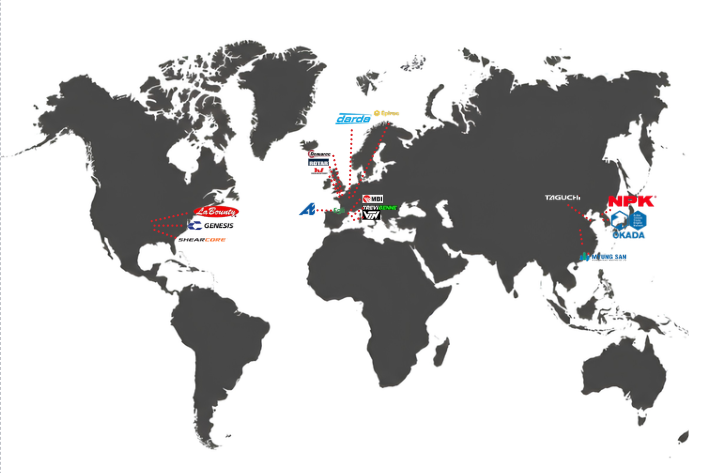
5. Worldwide Manufacturers & Industry Trends
5.1 Global Manufacturers 8
5.2 Industry Associations & Market Trends 9
6. High Reach Demolition 10
7. Primary Demolition
7.1 Primary Demolition Tools 11
7.2 Multi-Service Attachments & Primary Crushers 12
8. Secondary Demolition Tools 13
9. Steel Shears
9.1 Steel Shears & Applications 14
9.2 Variations & Industry Evolution 15
10. Special Applications & Future Trends 16
11. Find the Right Attachment 17
Welcome from the Author
Dear Dealer,
Over the years I have inspected, traded and analysed hundreds of demolition attachments worldwide.
This guide has been created to share practical knowledge gained through field experience, international networking and continuous observation of the demolition industry.
Whether you are an experienced dealer or entering this sector for the first time, I hope these pages will help you make better business decisions.
Thank you for taking the time to read this guide. I hope it provides valuable insights and helps you make informed decisions in your daily business.
P.S. Any feedback, suggestions or additional insights you would like to share would be greatly appreciated. Please feel free to contact me directly at info@repalo.it
PASQUALE DEPALO
ABOUT THIS GUIDE
Choosing the right demolition attachment requires more than comparing specifications. It requires understanding how tools evolved, how they work and where they perform best.
Over the following pages, you will discover how the main demolition tools work, how they differ from one another and which manufacturers have shaped the industry over the years.
The content has been developed primarily for dealers and professionals operating in the demolition sector, with the aim of sharing practical knowledge gained through field experience, international networking and continuous market observation.
Whether you are an experienced dealer or approaching this market for the first time, this guide is designed to help you make more informed decisions and better understand today’s demolition attachment industry.
MODERN DEMOLITION
Modern demolition attachments originated in Japan in the 1970s, driven by two key factors: the need for safer, more controlled demolition in densely populated urban areas, especially at height, and the widespread use of heavily reinforced earthquake-resistant concrete structures.
As traditional hydraulic breakers proved insufficient, more powerful and precise demolition tools were developed.“Concrete structures in Japan are considerably stronger and contain much more reinforcement than those commonly found in Europe. As a result, we routinely require heavier and more powerful demolition tools capable of handling these demanding applications.”
Mr. Watanabe
CEO, Watanabe Demolition – Japan
The first Japanese companies to develop demolition shears were OKADA, followed by NPK.
DEMOLITION SHEARS
Demolition shears consist of the following main components (see diagram) and operate on the hydraulic lever principle, using a fulcrum (pivot pin) and a movable jaw.
Crushing force depends on oil flow, hydraulic pressure, and the distance between the moving and fixed points. As with hydraulic breakers, the excavator provides the power through its oil flow (L/min) and pressure (bar).
Although they may appear simple, demolition shears are built around complex mechanisms, including:
- Hydraulic rotation motor
- Double-acting hydraulic cylinder
- Rotary joint
- Slewing ring
- Pinion
- Interchangeable blades or teeth
DEMOLITION SHEARS
A simple way to understand how demolition shears work is to “follow the oil.”
Oil flow (L/min) determines the jaw opening and closing speed, while hydraulic pressure (bar) generates the cutting and crushing force.
Since speed and force are inversely proportional, an efficient shear is designed to achieve the best balance between the two.
Systems such as booster valves and regenerative circuits can increase force without reducing speed, but if not properly designed or sized, they may compromise the efficiency, reliability, and service life of the hydraulic cylinder.
Worldwide Manufacturers & Industry Trends
Demolition companies and the leading commercial operators in the demolition industry are represented by national trade associations.
These associations aim to promote and represent the interests of the industry, as well as to foster the exchange of information and working methods related to demolition.
Leading associations include IDE and AEM, the latter being the American organization that certifies the technical data and performance parameters provided by leading equipment manufacturers.National demolition associations promote collaboration and represent the interests of the industry. They provide members with a collective voice and engage in advocacy in the best Anglo-Saxon tradition, supporting the demolition sector as a whole.
High Reach Demolition
Demolition performed using purpose-built, modified, or standard excavators capable of reaching heights over 30 m, allowing the safe demolition of complex structures at significant elevations.
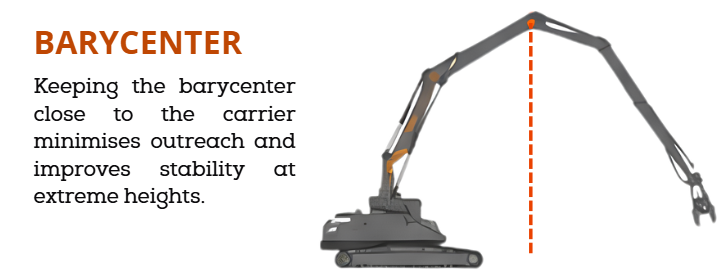
Ultra High Reach (UHD) refers to demolition excavators with a working height above 48 m. Equipped with modified undercarriages, tilting cabs, upgraded counterweights, and enhanced hydraulic systems, some models can reach operating heights exceeding 70 m.UHD demolition requires attachments with a wide jaw opening and a compact centre of gravity to minimise outreach and improve stability. Single-cylinder horizontal primary crushers are generally preferred, with continuous development focused on more compact, better-balanced designs for operation at extreme heights.
The first long-reach excavators were introduced in the 1970s by Richard Melhuish, founder of Land & Water. Today, only a few specialist manufacturers build or convert Ultra High Reach (UHD) machines.
PRIMARY DEMOLITION
Primary Demolition refers to the first mechanical stage of dismantling structures, starting from the top.
The equipment used for this type of demolition includes:
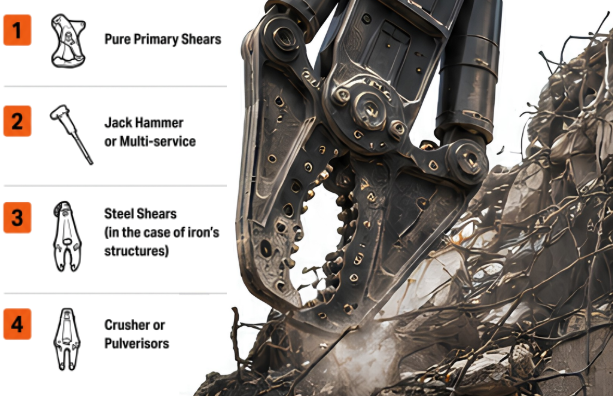
MULTISERVICE attachments can operate as both primary and secondary crushers by changing jaw kits according to the task required.
SHEARS are cutting attachments designed specifically for steel or high-strength steel profiles, and will be explained in more detail later.
PRIMARY CRUSHERS
These are next-generation attachments designed to operate without the need to replace the jaws, making them suitable both for the demolition of reinforced concrete beams and columns and for cutting the steel reinforcement embedded within the structure.
- The main interchangeable elements are the blades, which act as shears, while the teeth are responsible for crushing the external concrete and reinforcement.
SECONDARY DEMOLITION TOOLS
Secondary demolition follows the primary phase and involves breaking concrete elements (slabs, beams, pipes) into smaller pieces and separating or pulverising reinforced material. Secondary crushers, also called pulverisers, can be fixed or hydraulically rotating.
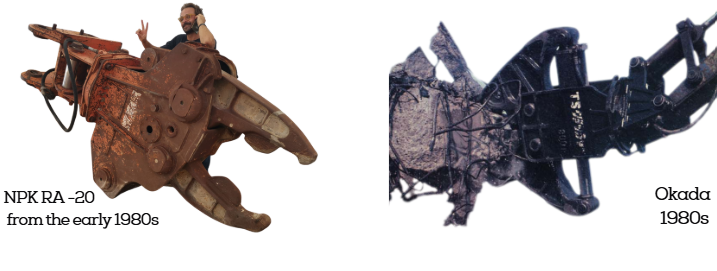
Originally simple, these tools have evolved mainly in the design of the teeth. Early models had fixed pointed profiles cut from the jaw plate and required periodic rebuilding by welding, while modern versions use removable and replaceable teeth supplied as spare parts (see NPK photo below).
STEEL SHEARS
While crushers and pulverisers are often interchangeable depending on the operator and application, making the distinction largely a matter of preference, certain applications require a specific tool: The Steel Shears.
Key Features
Used exclusively for cutting steel structures.
Can also be mounted in place of the excavator arm.
Narrow cutting width than a crusher but delivers higher cutting force.
Elongated design with the cylinder as perpendicular as possible to the moving jaw for maximum cutting efficiency.
A shear differs from a crusher thanks to its more elongated structure, which accommodates a larger cylinder and a smaller jaw area to concentrate high cutting force on steel,
H-beams, and railway tracks.
This design sacrifices jaw opening capacity in favour of cutting performance, while retaining the same core components as crushers and pulverisers.
Industry Evolution
In the demolition of steel structures—such as railway tracks, power plants, frames, engines, gears, and in sectors like automotive dismantling, shipbreaking, and aircraft recycling—shears play a key role.
Their use is expected to increase as modern construction increasingly relies on metal rather than brick, cement, or reinforced concrete.
Why Steel Shears Matter
The shear is expected to become increasingly important at the expense of concrete demolition, as modern construction relies more and more on metal and less on brick, cement, and reinforced concrete.
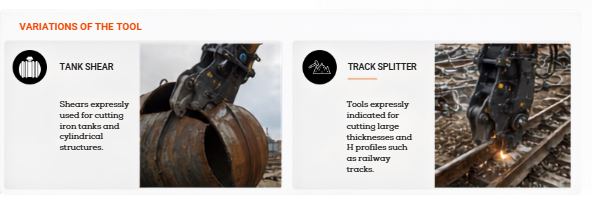
Special Applications & Future Trends
Innovation and technology are driving demolition towards safer, smarter and more efficient solutions.
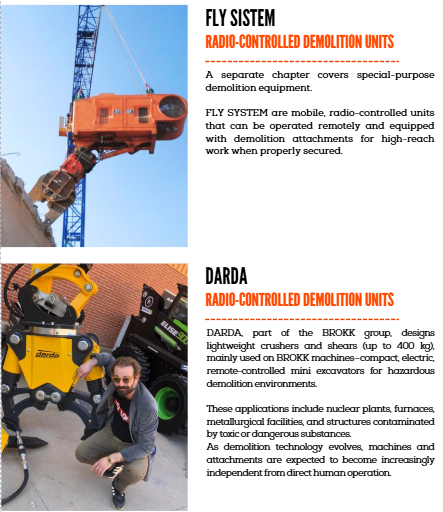
Here are two key examples of specialized applications shaping the future of the industry.